Belgian Integrity Awards 2026
The call for entries for the 2026 “Belgian Integrity Awards” closed a month ago. We received approximately 15 submissions, and based on the established criteria, the selection committee has shortlisted 12 projects. Discover the list of projects nominated for the 2026 edition—revealed here for the first time!
Last Thursday, the 19th, a jury, comprising experts in integrity from both the public and private sectors, met to select the winners.
The three winning projects will be unveiled on December 7th at KBR. If you haven’t reserved your spot yet, be sure to do so soon; only a few places remain!: Registration-Belgian Integrity Awards Ceremony 2026 – Fill in form.
Awards criterias:
As a reminder, selected projects must have significantly contributed to improving the fight against corruption or promoting greater integrity, transparency, and accountability in the civic space, public and/or private sectors in Belgium. The contributions may have been carried out: as part of prevention policies, to improve the detection of corruption and related breaches, as a reaction measure (sanctioning, settlement, ..). These contributions must take place in 2026 or be completed by 2026. There are no restrictions on the project start date.
The selected projects can take various forms: research project, creation or strengthening of an integrity policy, a publication, an awareness-raising campaign, etc.. Projects and initiatives may have been carried out during working time and be remunerated or created in an associative environment of civic space carried out by non-profit volunteers (NGO, Civic society organisations, Sportsclub, ASBL, …).
All initiatives or projects were judged by the jury if they related to one of the following themes: fight against corruption, transparency, integrity, and/or accountability, if they have social impact, are creative and innovative, and sustainable.
List of the nominated projects:
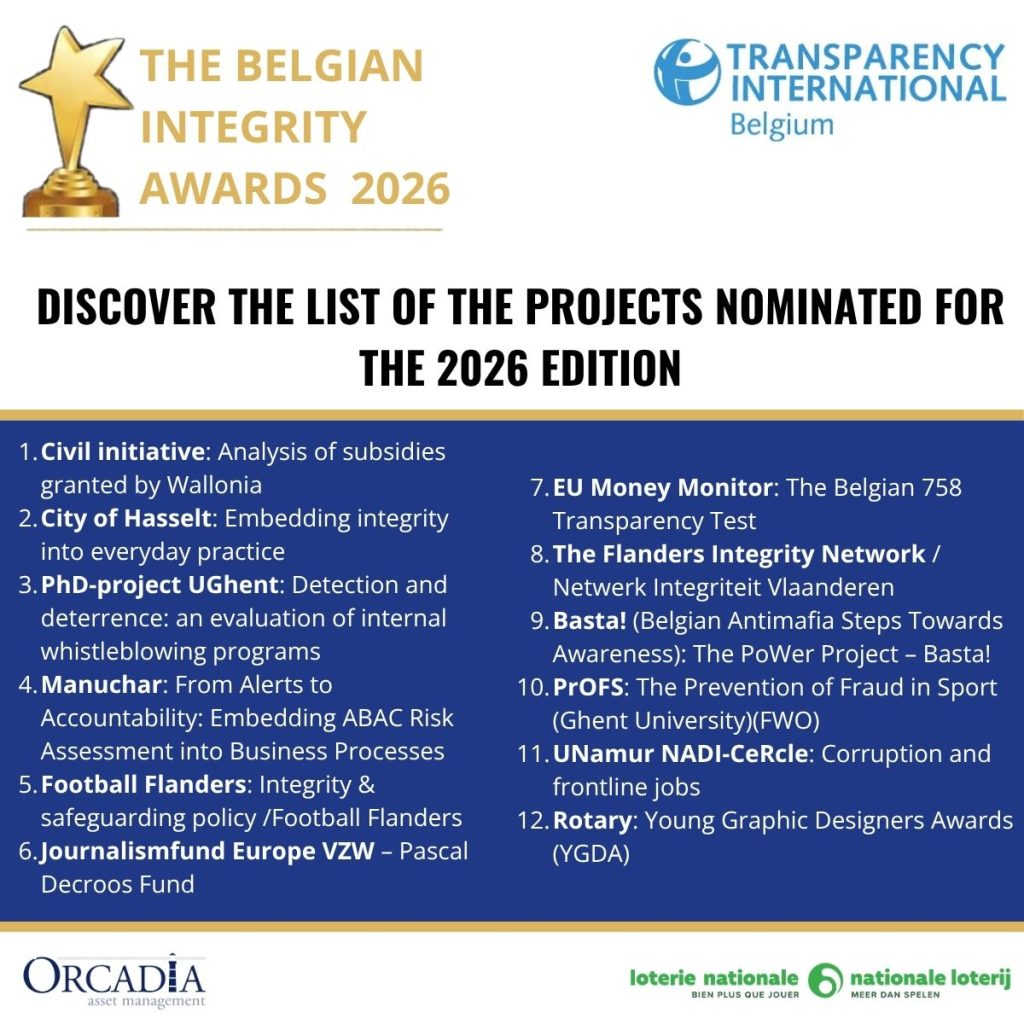
Learn more about the projects:
1. Civil initiative: Analysis of subsidies granted by Wallonia
The project summary: This project strengthens integrity, accountability and transparency in public funding by making information on public grants accessible, understandable and usable for local authorities, social welfare organisations and non-profit associations.
By reducing information inequalities, it promotes fair access to public resources and more transparent public decision-making.
Civil Initiative: The project in 2026: Publication of “Moyens financiers : les subsides octroyés par la Wallonie” (Vanden Broele, August 2026, 170 pages), a practical guide to identifying and accessing regional public funding.
- Continued publication of specialist articles on FinancesConnect (public-sector finance platform): more than 190 articles since January 2023.
- Development and dissemination of practical methodologies helping associations identify suitable grants, prepare applications and secure funding.
- Continued work to promote equal access to public funding, particularly for smaller municipalities, social welfare organisations and voluntary associations lacking dedicated resources.
The organization: This application is submitted through Vanden Broele, a Belgian publishing house specialising in professional and public-sector publications. Vanden Broele publishes the specialist books at the heart of the project, including Moyens financiers : les subsides octroyés par la Wallonie (August 2026, 170 pages), which helps local authorities, social welfare organisations and non-profit associations identify and access public funding.
The project is led by Thibaut Naniot, author of several books on public funding and grant management published since 2010, and a regular contributor to FinancesConnect. He has served as Municipal Chief Executive Officer of the Municipality of Sombreffe, Belgium, since 2010.
Contact: Thibaut Naniot – naniot_thibaut@yahoo.fr
2. City of Hasselt: Embedding integrity into everyday practice
The project summary: The City of Hasselt has embedded integrity into the daily work of employees at all levels of the organization, transforming it from a compliance requirement into a shared organizational responsibility. Through continuous awareness initiatives, dilemma-based workshops, accessible advice and reporting channels, strong governance structures, monitoring, transparent reporting, and ongoing dialogue, the city fosters a culture of integrity, accountability, and transparency in public service.
The project in 2026: Further embedded a comprehensive integrity framework across the organization, integrating policies, prevention, training, reporting procedures, governance structures and continuous monitoring into everyday operations.
Implemented recurring organization-wide initiatives, including integrity quizzes and gamified workshops based on real-life dilemmas, reaching all levels of the organization, from technical services to the municipal council.
Strengthened accountability through an annual integrity action plan, an Integrity Committee, and transparent reporting of integrity-related figures to political bodies, senior management, trade unions and employees, while safeguarding confidentiality in individual cases.
Increased awareness and trust, as reflected in the high visibility of the integrity programme and the growing number of integrity-related questions and reports received. Integrity has evolved into a shared responsibility across the organization, empowering employees across all roles and functions to recognize, discuss, and address integrity challenges as part of their day-to-day work.
The organization:
The City of Hasselt is a Belgian local public authority serving over 80,000 residents. Guided by its ambition to be a warm, people-centred city that puts quality of life first, Hasselt brings together diverse public services and invests in a trustworthy, inclusive and forward-looking community.
Contact: Heidi Paesen, afdelingshoofd organisatiebeheersing, heidi.paesen@hasselt.be
3. PhD-project UGhent: Detection and deterrence: an evaluation of internal whistleblowing programs
The project summary: Dwight defended his PhD thesis entitled “Detection and deterrence: An evaluation of internal whistleblowing programmes as a dual-purpose organisational control” in Business Economics at Ghent University in June 2026. He undertook his PhD research from October 2021 to June 2026 under the supervision of Prof. Dr Sophie Maussen and Prof. Dr Sophie Hoozée. His doctoral thesis evaluates how different design choices can make internal whistleblowing programmes more effective. In addition to making important academic contributions, his research also has practical implications in the field of integrity.
How the project contributes to integrity, accountability, and transparency in Belgium: Whistleblowing means: more transparent and working on integrity. Dwight’s doctorate is about internal whistleblowing where integrity is central.
The organization: The research project was funded with a prestigious grant from the Scientific Research Fund. Waeye Dwight is the main researcher for this project.
4. Manuchar: From Alerts to Accountability: Embedding ABAC Risk Assessment into Business Processes
Project summary: Development of a third party risk assessment platform: In May 2026, Manuchar completed a HQ-led, worldwide transformation of Compliance Catalyst, its third-party risk-assessment platform. The project moved Manuchar from identifying corruption risk in selected situations to systematically assessing every direct third party worldwide for anti-bribery and anti-corruption (ABAC) risk, alongside sanctions risk. The revised model considers defined indicators, including a third party’s activities/industry, government ownership and public-sector connections, relevant ownership information, and adverse integrity findings. Unresolved concerns cannot simply be noted and ignored: they may trigger enhanced due diligence, contractual safeguards, Compliance review and approval, mitigation, or prohibition of the relationship.The final model resulted from a multi-year process of design, portfolio-wide testing, external input, and refinement. Manuchar analysed which indicators generated meaningful outcomes and recalibrated overly broad factors that produced false positives.The project qualifies because it converts anti-corruption commitments into a preventive and enforceable business control. ABAC assessment is now fully integrated into standard third party onboarding, and identified risks lead to documented decisions and concrete consequences.
How the project contributes to integrity, accountability, and transparency in Belgium: Integrity is central because every direct third party is assessed against the same ABAC standard, regardless of commercial value or location. Where a material concern cannot be resolved, the relationship may be prohibited.
Transparency is created through a structured and traceable assessment. Compliance Catalyst records relevant risk indicators, the review performed, supporting information, and the final outcome, enabling oversight and continuous improvement. Accountability means that a warning cannot simply remain on file. Potential risks must be investigated and resolved through a documented decision, which may require enhanced due diligence, contractual safeguards, mitigation, senior Compliance approval, or rejection. Together, these values turn Manuchar’s anti-corruption commitment into daily practice: integrity sets the standard, transparency makes the reasoning visible, and accountability ensures that identified concerns lead to action.
The organization: Manuchar and its compliance team
5. Football Flanders: Integrity & safeguarding policy / Voetbal Vlaanderen
Project summary: We transformed a community with a culture of silence into one where people speak up, supported by clear procedures and over 1,800 trained Integrity Officers. Reaching more than one million people every week, we set a clear standard for safe, fair, and transparent governance in Belgian sports.
The project in 2026: Accomplishments:
- Speak-up culture: Reports from victims and whistleblowers grew by 30% each year since 2023, reaching over 1,700 cases annually (more than all other Flemish sports combined).
- Working locally: In 2026, we reached the milestone of 1,800 trained Club Integrity Officers (Club-API’s) supporting clubs on the field every weekend.
- Dedicated team: This year, we hired a second full-time integrity specialist, funded entirely with our own resources, to handle cases objectively.
- Research & Collaboration: We ran multi-year research with Thomas More, launched an explanatory video, and worked closely with the RBFA, FFA, Sport Vlaanderen, and other federations through our Share Day.
The organization: Voetbal Vlaanderen is the Flemish wing of the Royal Belgian Football Association (KBVB/RBFA) and the largest sports federation in Flanders, responsible for organizing and promoting football across the Flemish Community.
Contact information:
Ismail Eddegdag
(0484781033 / ismail.eddegdag@voetbalvlaanderen.be
6. Journalismfund Europe VZW - Pascal Decroos Fund
The project summary: We believe that journalism is crucial to fostering living democracies. You can’t change what people don’t know. We are dedicated to advancing independent and investigative journalism that serves the public interest, furthers accountability as well as transparency, and contributes to critical thinking and informed debate.
The project in 2026: To date, we have received 1,016 funding applications from across Europe for 2026. (We have supported 257 projects, but there is still one more judging panel meeting to go.) Of these, 154 are Belgian applications. 63 Belgian projects received funding this year.
We distinguish between the impact of our work on the world of journalism, and the direct impact of the investigations that we support. Either type is often not immediately visible and measurable. However, some investigations do lead to visible change, and our grant programmes have also led to increased capacity of investigative journalism in Belgium and beyond. Below is a selection of publications and impact stories from 2026, drawn from investigations on a range of topics supported by our grant programmes in Belgium.
The organization: Journalismfund Europe vzw is a Brussels-based independent non profit intermediary, founded in 1998as a citizens’ initiative under the name Fonds Pascal DecroosOpens in a new tab. It is dedicated to strengthening democracy across Europe by advancing cross-border investigative journalism that serves the public interest, furthers accountability and transparency, and contributes to critical thinking and well-informed debate. Its overall objective is to promote and improve the profession in response to the challenges and opportunities stemming from internationalisation, digitalisation and changing revenue models.
Journalismfund Europe’s flexible grant programmes enable journalists and media to produce relevant stories of public interest with a European mind-set, from international, national and regional perspectives. Where necessary, it mentors and supports investigative teams that have strong ideas but lack the experience and infrastructure to work across borders.Journalismfund Europe acts as a firewall between donors and journalists. This intermediary role is essential to enable donors to fund investigative journalism without risk and without compromising the credibility and independence of the journalists or media. Journalismfund Europe respects the editorial independence of its grantees and strives for high journalistic quality and rigour.
Risk management is built into every stage of its work.
- Contact: info@journalismfund.eu – office: +32 2 705 59 19
7. EU Money Monitor: The Belgian 758 Transparency Test
The project summary: Transparency in speeches is easy. In Belgium’s official registers, 391 organisations awarded €2.65 billion in EU money labelled “NGO” or “non-profit” score low on what a citizen can verify. And when the public debate says “NGO funding”, NGOs received 28% of all EU money under these labels in Belgium, and 9% of everything the EU awarded to Belgian “Private Companies” – the broader category the EU files the two labels under.
The project in 2026: Integrity needs a public record. I checked the 758 organisations behind 92% of the EU money labelled “NGO” or “non-profit” in three official Belgian registers: only 75 pass the Transparency Test, and 285, awarded €1.74 billion, show no official public financial disclosure.
The European Court of Auditors wrote that the Belgian mechanism I described “might be one of the information sources in our future audits”.
The organization: EU MONEY MONITOR. Independent investigative journalism on how the EU spends public money, and who checks it; founded in Brussels by Anca Păduraru, investigative journalist and data scientist.
Citable methods: DOI 10.5281/zenodo.20685588 · DOI 10.5281/zenodo.20690853
+32 489 63 82 20
money-monitor.eu/intelligence
8. The Flanders Integrity Network / Netwerk Integriteit Vlaanderen
The project summary: For over 15 years, the Flanders Integrity Network has brought together integrity professionals from different levels of government, the private sector and academia to strengthen integrity through trust, open dialogue and shared expertise. By creating a confidential space where professionals can challenge each other, exchange real-life dilemmas and translate knowledge into practice, the network helps build more ethical, accountable and transparent organizations across Belgium.
The project in 2026: In 2026, the Flanders Integrity Network put ethical leadership and the courage to speak up at the heart of its activities. Through two in-depth sessions, members explored how integrity can be strengthened not only through rules and procedures, but through everyday leadership, organizational culture and professional behaviour.
A key highlight was the session on ethical leadership, bringing together practical experience and expert insights into leadership, values, moral courage, psychological safety and responsible followership. The discussion showed how leaders can create environments in which people feel able to speak up, challenge decisions respectfully, take responsibility and remain true to shared values. Earlier in the year, the network focused on speaking up freely, exploring the conditions that enable professionals to raise concerns and discuss integrity dilemmas openly and constructively.
Beyond these formal sessions, the network continued doing what has made it valuable for more than 15 years: connecting people who work on integrity in very different contexts and enabling continuous exchange of knowledge, experience and good practices between meetings. Its strength lies in that combination: a trusted network, cross-sector expertise and a strong connection between reflection and practice. Integrity is not treated as a compliance exercise, but as something professionals and leaders build together, every day.
The organization: The network was founded by prof. dr. Jeroen Maesschalck. The Flanders Integrity Network is an independent professional network that has been bringing together integrity practitioners for over 15 years. Its members come from different levels of government, some private sector ethic specialist and academia, creating a unique cross-sector community around integrity, ethics and good governance.
The network meets twice a year for an in-depth exploration of a current integrity theme. Between meetings, members remain connected and exchange expertise, experiences, tools and practices. Confidentiality, active participation and mutual trust are central to the network, allowing members to engage openly with complex and sometimes sensitive integrity challenges.
The network thrives on the enthusiastic and voluntary commitment of its members, who contribute their expertise, ideas and energy to its activities. Rather than relying on a heavy formal structure, it is sustained by shared ownership and a genuine willingness to learn from and support one another. Communication and practical coordination are centralized through Lies Van Cauter, who serves as the network’s central point of contact.
Lies Van Cauter, public servant and head of Strategy at the municipality of Maldegem
0486 68 90 18, lies.van.cauter@maldegem.be
9. Basta! (Belgian Antimafia Steps Towards Awareness): The PoWer Project
The project summary: The PoWer project strengthens integrity and transparency in Belgium by bridging the gap between the country’s complex, multi-level whistleblowing legislation and its practical accessibility in public procurement. By uncovering systemic reporting barriers, developing targeted training, and advocating for clearer reporting pathways and stronger public oversight, the initiative enhances institutional accountability and safeguards public funds against corruption.
The project in 2026: National Data Collection Report on Public Procurement: Conducted in-depth legal and policy desk research alongside semi-structured interviews with key stakeholders—including an official from the Federal Ombudsman, an investigative journalist, a legal practitioner, and an NGO representative—to map Belgium’s fragmented whistleblower framework, identify protection gaps for subcontractors and vulnerable workers, and formulate concrete policy recommendations. Bilingual Training Needs Survey Rollout: Designed and launched a nationwide survey in Dutch and French to assess practical knowledge, reporting barriers, and capacity needs among public procurement professionals, civil servants, and civil society actors. Multi-Stakeholder Engagement & Awareness: Connected institutional actors, legal experts, media, and civil society networks across Belgium through targeted outreach and bilingual communications, laying the evidence-based foundation for tailored capacity-building modules.
The organization: BASTA! vzw / asbl (Belgian Antimafia: Steps Towards Awareness) is a non-profit organization committed to countering organized crime, corruption, and mafia-type infiltration through research, awareness-raising, education, and European cooperation.
Working alongside citizens, youth, professionals, and policymakers, BASTA! promotes a culture of legality, strengthens the rule of law, and advocates for the social reuse of confiscated criminal assets in Belgium and across Europe.
Organization: BASTA! vzw / asbl
Email: basta.asbl@gmail.com
10. PrOFS: The Prevention of Fraud in Sport - Ghent University (FWO)
The project summary: PrOFS strengthens integrity in sport through a multidisciplinary and systems-based approach to fraud prevention, generating evidence-based insights into fraud risks across athletes, organisations, and governance and legal structures. Through research, education, stakeholder engagement, and practical prevention tools, the project increases awareness and promotes a culture of integrity and accountability throughout the sport sector.
The project in 2026: PrOFS completed several key prevention tools, including an elite athlete workshop, e-learning modules, and a fraud prevention competition-planning tool, and expanded the project with new research initiatives focusing on the role of bystanders and club-level fraud risk assessment.
These activities aim to support the denormalisation of both sporting and organisational fraud across the sport sector.
The organization: The lead organization is the Sport Management team of Ghent University, with prof dr Annick Willem (annick.willem@ugent.be) as principal investigator.
For the PrOFS project, the team collaborated with four other research units at Ghent University and KULeuven.
11. UNamur: NADI-CeRcle: Who get served, and why: understanding and preventing corruption in frontline service encounters
The project summary: Corruption is not only about big scandals: it can also happen at the front desk, when a favour, a gift or the right contact decides who gets served first. This research brings these hidden risks to light, helping organisations in Belgium and beyond build services where access depends on need, not on connections.
The project in 2026:
A hospital appointment, a place in social housing, a permit: every day, frontline employees make decisions that shape people’s access to essential services. This PhD project examines how corruption can enter these everyday encounters, what it costs service users, and how it can be prevented.
What we achieved in 2026
- New frameworks: conceptual tools that explain how corruption arises at the front line, how it can distort who gets served (“allocation capture”), and the hidden burdens it places on service users.
- Voices from the field: in-depth interviews with 17 international experts and practitioners in corruption, governance and service research from 11 different countries.
- International recognition: the 2026 ServCollab Scholarship Award (sponsored by the American Marketing Association/SERVSIG) for the project’s contribution to service research.
- Global reach: connecting service research with international anti-corruption expertise, including the United Nations PRME Working Group on Anti-Corruption.
Our goal: fairer, more transparent and more accountable services, where everyone is treated on the same terms.
The organization: NADI-CeRCLe, University of Namur (Belgium) – Research Center in Service and Marketing Management at the UNamur School of Management (UNSM), Faculty of Economics, Management, Communication and Politics (EMCP).
A leading, internationally recognized center for service management research. Within the center, this project studies ethical challenges in service delivery, with a focus on corruption, fairness and integrity.
Project lead: Flamure Ibrahimi, PhD Researcher and Teaching Assistant
In collaboration with: Prof. Wafa Hammedi (University of Namur, Belgium), Prof. Linda Alkire (Texas State University, USA) and Prof. Gazi Islam (Grenoble École de Management, France).
Email: flamure.ibrahimi@unamur.be
12. Rotary: Young Graphic Designers Awards
The project summary: Since 2007, the poster competitions organized by the Young Graphic Designers Awards have aimed to prompt young people to reflect on the fundamental importance of values such as tolerance, solidarity, respect, fair play, and freedom—and, more broadly, on the concept of living together.
The project in 2026: In 2026, following the principle of “youth speaking to youth,” young graphic designers are replacing words—which lack the infinite power of an image—with posters. These posters promote the theme of the 20th edition: integrity. The initiative launched on October 15, 2026.
A testimonial from a participant:
“I am taking part in the Rotary poster contest because I want to create something that carries a message and can resonate with others. I’m happy to be able to express my ideas through a visual creation and, in my own way, contribute to raising public awareness about a social issue. This experience has helped me realize that a poster isn’t just something to look at; it can also prompt reflection, convey values, and spark reactions.“
Roxane Dor – 6QA – Institut technique René Cartigny
The organization: The team consists of 10 Rotarians from diverse professional and cultural backgrounds who meet at least once a month to organize the poster contest.
They share one common foundation: the four key questions that form the basis of Rotary’s ethics namely:
Is it the truth? Is it fair to all concerned? Will it build goodwill and better friendships? And will it be beneficial to all concerned?
NL contacts: Bart Henny,
Contacts FR: Michel Stricklesse
Secretariat: Françoise Miot
Communication: Rémy Muzembo
President: Michel Stricklesse
Vice-President: Jan van Laarhoven
Committee Members: Eric Gérard, Joris Debaes, Raf van Huyck, Joost Vander Auwera, Patricia Dewez.
https://younggraphicdesigners.be
tel : +32(0)2.345.61.99